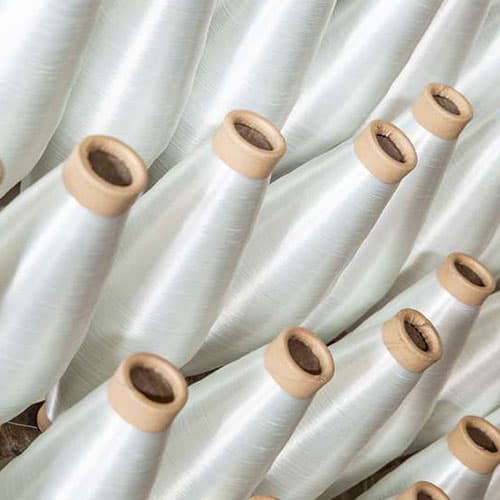
Glass Fiber Yarns Technical Data Sheet (TDS)
Glass Fiber Yarns are continuous filament strands composed of E-glass or other specialty glass materials. These yarns are primarily used as reinforcement media in weaving, braiding, knitting, electrical insulation, and composite production. With high tensile strength, electrical resistance, and thermal stability, glass fiber yarns are critical for aerospace, electronics, filtration, and textile applications.
Product Description
| property | value |
|---|
| Product Form | Continuous filament yarns (single or plied) |
| Glass Type | E-glass (alkali-free), optional S-glass or C-glass |
| Tex Range | 17 – 2400 tex |
| Yarn Construction | Single yarn, 2-ply, 3-ply, 4-ply twisted yarn |
| Twist Direction | S, Z or SZ |
| Sizing Agent | Silane, starch-oil, or PU-based (customized for resin systems) |
Technical Specifications
| property | value |
|---|
| Filament Diameter | 6 – 13 μm (commonly 9 μm) |
| Linear Density (Tex) | 17 – 2400 tex (custom spools available) |
| Breaking Tenacity | ≥ 0.6 N/tex (depends on tex and ply) |
| Elongation at Break | 2.5 – 4.0% |
| Moisture Content | < 0.2% |
| Loss on Ignition (LOI) | 0.5 – 2.0% (dependent on sizing) |
| Thermal Resistance | Continuous: 550°C, Short-term: 700°C |
| Electrical Conductivity | Non-conductive (dielectric strength > 10 kV/mm) |
| Density | 2.58 g/cm³ |
| Color | White or slightly off-white (natural glass) |
Performance Characteristics
| property | value |
|---|
| Dimensional Stability | High dimensional precision under thermal or mechanical stress |
| Heat Resistance | Retains tensile strength and stability at high temperatures |
| Electrical Insulation | Excellent dielectric properties for winding and cable wrapping |
| Chemical Stability | Resistant to acids and solvents (except HF) |
| Weaving & Knitting Compatibility | Smooth surface and high integrity enable fabric forming |
| Sizing Compatibility | Customized sizing available for epoxy, polyester, PA, PP |
Application Fields
| property | value |
|---|
| Woven Fabrics | Used as warp and weft yarns for glass fabrics, tapes, and mesh |
| Electrical Insulation | Used in transformer windings, motor insulation, cable tapes |
| Thermal Protection | Knitted or braided sleeving for heat shielding and fireproofing |
| Filtration Media | Wound filter cartridges, woven air/liquid filtration |
| Composite Reinforcement | RTM, filament winding, prepreg production |
| Textile Industry | Used for sewing thread and heat-resistant textiles |
Available Yarn Types
| property | value |
|---|
| Single Yarn | Standard for weaving, high flexibility |
| Twisted Yarn | Improved tensile properties and dimensional stability |
| Ply Yarn | Multiple ends twisted together (2-ply, 3-ply, 4-ply) |
| High-Twist Yarn | For sewing and reinforcement applications |
| Texturized Yarn | Bulky yarn with enhanced thermal insulation |
| Coated Yarn | Surface-treated for specific resin or processing requirements |
Handling & Storage Guidelines
- Store in dry, shaded, and well-ventilated environments
- Avoid moisture absorption; reseal after opening
- Use gloves during handling to avoid glass fiber skin irritation
- Avoid excessive tension or mechanical stress during rewinding or transfer
- Use within 12 months for best weaving and adhesion performance
Quality Control & Testing
| property | value |
|---|
| Linear Density Test | ISO 1889 / ASTM D1907 |
| Tensile Strength Test | ISO 3341 / ASTM D2256 |
| LOI Test | ISO 1887 / ASTM D2584 |
| Filament Diameter | Laser diffraction or SEM microscopy |
| Sizing Uniformity | Weight variation and adhesion performance test |
We supply custom yarn grades for resin infusion, high-speed weaving, 3D fabrics, and electrical wrapping. Spool types and tex values can be tailored for automated weaving and braiding systems. Contact us for COA, SDS, and OEM solutions.