OC Roving 600 tex
OC · Global Glass Supplier
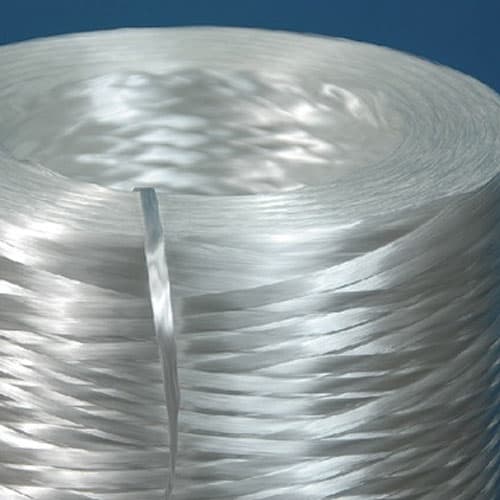
OC Roving 600 tex
SMC / BMC
Technical Specifications
| Linear Density | 600 tex |
|---|---|
| Type | Chopped |
| Compatible Resin | UP |
| Application | SMC / BMC |
| Supplier | Global Glass Supplier |
Glass Fiber Roving Technical Data Sheet (TDS)
Glass fiber roving is a bundle of parallel continuous E-glass filaments, designed for reinforcement applications in composites. It offers high tensile strength, corrosion resistance, and excellent compatibility with a variety of resin systems.
Product Classification
| property | value |
|---|---|
| Product Types | Direct Roving (DR), Assembled Roving (AR) |
| Fiber Composition | E-glass (Alkali-free borosilicate glass) |
| Tex Range | 200 – 4800 tex |
| Filament Diameter | 13 µm, 16 µm, 17 µm, 24 µm (customizable) |
| Resin Compatibility | Unsaturated Polyester (UP), Vinyl Ester (VE), Epoxy (EP), Polyurethane (PU), Phenolic |
| Sizings | Silane-based; customized surface treatment for improved resin wet-out |
Technical Specifications
| property | value |
|---|---|
| Linear Density (Tex) | 2400 tex (commonly used); other options: 300, 600, 1200, 2400, 4800 |
| Filament Count | 400 – 9600 filaments per strand |
| Moisture Content | ≤ 0.10% |
| Loss on Ignition (LOI) | 0.5 – 1.2% |
| Tensile Strength | ≥ 0.6 N/tex |
| Packing Weight | 15 – 25 kg per roll |
| Packaging | Cardboard bobbin, PE shrink wrap, palletized |
Mechanical Properties
| property | value |
|---|---|
| Density | 2.6 g/cm³ |
| Tensile Modulus | 72 – 76 GPa |
| Tensile Strength (Dry) | ≥ 2100 MPa |
| Elongation at Break | 2.5 – 4.8% |
| Thermal Conductivity | 1.0 – 1.2 W/m·K |
| Electrical Conductivity | Very low (excellent insulator) |
| Softening Point | 845°C |
| Melting Point | 1250°C |
Features & Advantages
- High tensile strength and stiffness for structural reinforcement
- Low fuzz and excellent unwinding performance for high-speed processing
- Good dispersion and resin wet-out for superior mechanical bonding
- Corrosion and moisture resistant, ideal for harsh environments
- Thermal and electrical insulation properties make it suitable for demanding composite systems
- Low LOI for clean processing in thermosetting resins
Application Processes
Glass fiber rovings are suitable for the following processes:
- Pultrusion – for profiles, rods, rebar
- Filament Winding – for tanks, pipes, pressure vessels
- RTM (Resin Transfer Molding) – for automotive and electrical components
- Spray-up and Hand Lay-up – for marine, construction
- Weaving / Knitting – to manufacture woven roving and multiaxial fabrics
- Sheet Molding Compound (SMC) – when chopped into strands
Typical Applications
- Wind turbine blades
- GRP pipes and pressure vessels
- Electrical cable cores and insulation
- Automotive leaf springs, hoods, and panels
- Building reinforcement bars (GFRP rebar)
- FRP bridge components, ladders, gratings
Storage & Handling
- Store in dry and well-ventilated areas, temperature 15–35°C, RH < 65%
- Avoid direct sunlight, moisture, and mechanical stress
- Keep in original packaging before use
- Recommended shelf life: 12 months from production date
Quality Assurance
All roving products undergo full in-process and final quality checks:
- Tex verification and strand uniformity
- Moisture content and LOI testing
- Strand tension uniformity during unwinding
- Compatibility test with target resin system
For customized sizing, filament diameter, bobbin type, or application-specific performance grades (e.g. for RTM, infusion, high-speed pultrusion), please consult our technical service team.