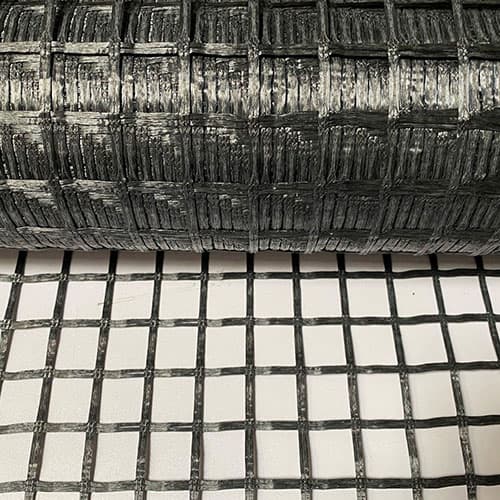
Glass Fiber Grids Technical Data Sheet (TDS)
Glass fiber grids are high-performance reinforcement structures made from alkali-resistant glass yarns arranged in biaxial configurations. These grids provide excellent tensile strength, crack resistance, dimensional stability, and are widely used in road reinforcement, asphalt overlays, concrete slabs, and geotechnical applications.
Product Overview
| property | value |
|---|
| Structure Type | Biaxial or triaxial grid of coated glass yarns |
| Glass Type | E-glass or AR-glass (Alkali Resistant) |
| Coating Type | Bitumen, polymer (e.g. PVC, SBR), or latex-modified adhesive |
| Yarn Configuration | Warp-knitted or stitch-bonded structure |
| Grid Aperture | 10×10 mm to 40×40 mm (customizable) |
Technical Specifications
| property | value |
|---|
| Nominal Grid Weight | 100 – 500 g/m² |
| Tensile Strength (Warp) | ≥ 50 – 120 kN/m |
| Tensile Strength (Weft) | ≥ 50 – 120 kN/m |
| Elongation at Break | ≤ 3.5% |
| Melting Point | > 850°C (glass fiber core) |
| Thermal Stability | -40°C to 200°C (depending on coating) |
| Alkali Resistance (ASTM D3045) | ≥ 90% strength retention after 28 days |
| UV Resistance | Excellent with polymer or bitumen coating |
Performance & Benefits
| property | value |
|---|
| Crack Control | Suppresses reflective and shrinkage cracks in concrete/asphalt |
| Load Distribution | Spreads traffic and stress loads across a wider area |
| Bonding | Strong interface bonding with asphalt or cement matrix |
| Fatigue Resistance | Reduces long-term stress and rutting in pavements |
| Moisture Barrier | Protects substrate from water ingress when combined with coating |
Common Applications
| property | value |
|---|
| Road Rehabilitation | Under asphalt overlays to delay reflective cracking |
| Concrete Slabs | Prevents micro-cracking and joint stress failures |
| Airport Runways | High-load reinforcement for concrete composite runways |
| Railway Subgrade | Enhances stability and distributes dynamic loads |
| Tunnel & Bridge Decks | Adds durability and controls vibration-induced fatigue |
Installation Guidelines
- Surface must be clean, level, and free of oil, dust, or moisture
- Apply bitumen tack coat or polymer-modified adhesive for optimal bonding
- Lay grid without tension or wrinkles; overlap by minimum 10–15 cm
- Use rollers to press the grid evenly into the base layer
- Apply asphalt or concrete overlay after the grid is properly fixed
Packaging & Storage
| property | value |
|---|
| Roll Size | Width: 1–5 m; Length: 50–150 m (customizable) |
| Inner Core | 76 mm paper or PVC |
| Outer Wrap | PE film or woven bag with product label |
| Palletization | Vertical stacked or horizontal rolls with shrink wrap |
| Storage | Dry, shaded, indoor area away from flame or chemical vapors |
| Shelf Life | 24 months under proper storage conditions |
Quality Control Standards
- Tensile strength and elongation per EN ISO 10319 / ASTM D6637
- Coating adhesion test for bitumen or polymer interface
- Grid spacing and dimensional tolerance per design spec
- Thermal aging and alkali resistance tests for long-term stability
- UV weathering performance per ASTM D4355
Customized formulations, widths, grid aperture sizes, and composite compatibility options are available. Our R&D team offers support in multilayer pavement design and geogrid selection for demanding environments.